Independent project
A Pokémon Guessing Game With 39 Ways to Play
A Pokémon guessing game with 39 modes under one handheld-console interface, from a daily Wordle-style challenge to trivia, hangman, and word search.
Visit the project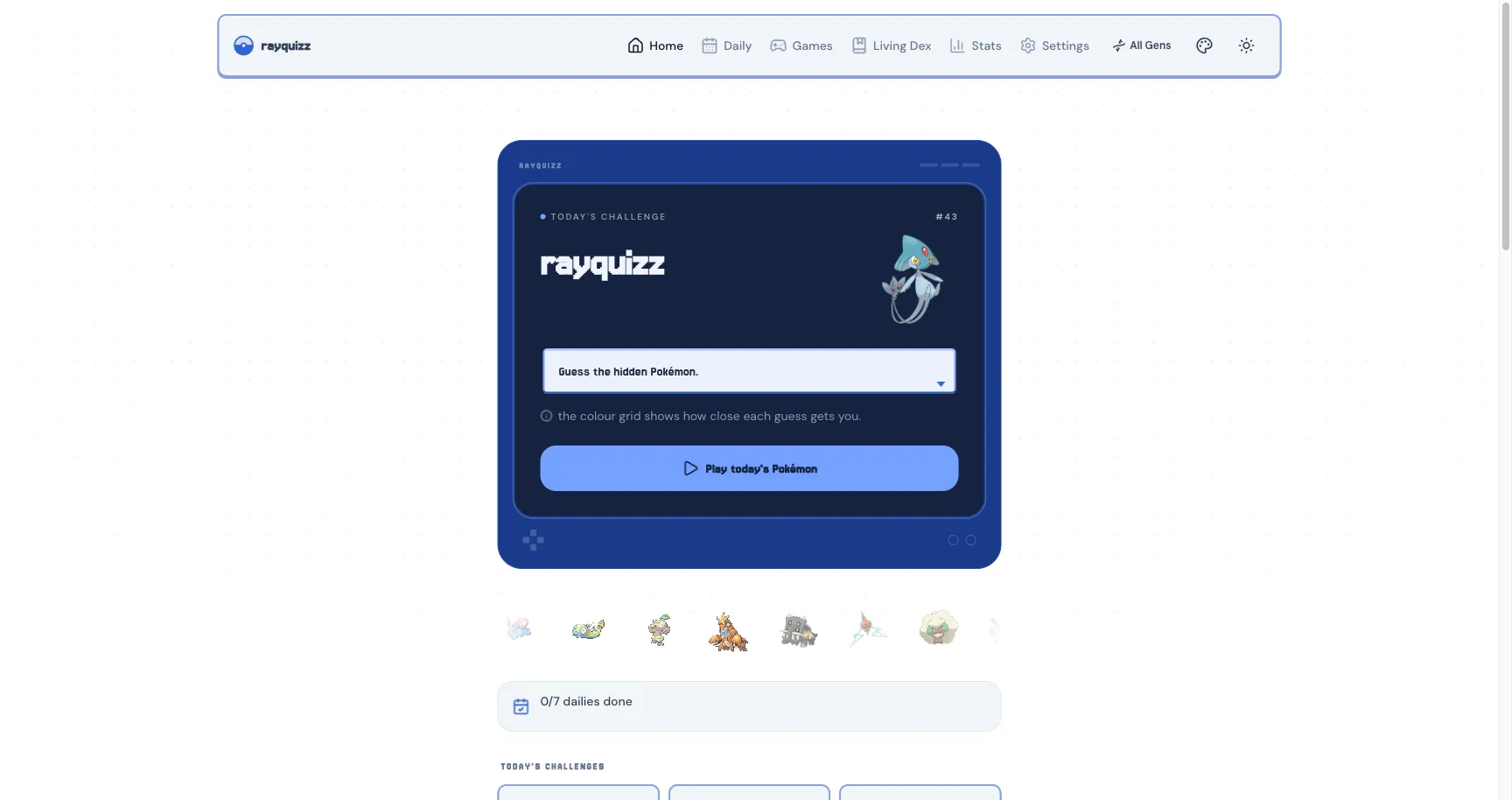
- Outcome
- An arcade of 39 modes that plays like a single machine, replayable daily, fast, and free
- The unconventional call
- Treating 39 game modes as one product: a handheld-console frame that makes a whole arcade feel like a single machine.
- Disciplines
- DesignSoftware Engineering
- Tags
- Web appInteractive webGame
- Delivered
- July 2026
My friends and I love the browser Pokémon dailies, and we kept running out of them by breakfast. rayquizz is what I built so the fun would not end at one puzzle a day.
Atlantic Forge
The stakes
My friends and I love the browser Pokémon guessing games. They have a ritual to them: solve the daily, compare results, argue about who got lucky. The trouble is that the ritual kept ending by breakfast. Nearly every game out there is daily-only, one puzzle and then a locked door until midnight, and the customisation barely exists: no picking your generation, no making the thing feel like yours. We kept wanting more game than the games would give us. So I thought what I always think: I can do better, and this time the brief came from the group chat. Build something that keeps me and my friends entertained past the first two minutes.
That set the real problem, because “more game” sounds like a content problem and is actually a design problem. rayquizz set out to be the most complete Pokémon guessing game on the web: thirty-nine distinct modes, trivia, hangman, word search, a daily hidden Pokémon, a Living Dex tracker. That collection will collapse into an incoherent menu of mini-games unless something strong holds it together, and it still has to serve both halves of the group: the friend playing a two-minute daily on a commute, and the one settling in for a long session across generations of content.
Thirty-nine modes is not a feature list. It is a coherence problem wearing a feature list.
The move
The frame is the product. Everything lives inside a handheld-console aesthetic, so the whole arcade reads as one machine: modes are what the console plays, not separate pages. A new mode slots into the fiction instead of stretching the navigation, which is what lets the collection grow to 39 without the product feeling like 39 products.
The same trick turns personalisation into play. Choosing your Pokémon generation and your console theme are, mechanically, a content filter and a colour scheme. Inside the frame, they feel like picking up your own console, and players switch them anytime.
What shipped
A Nuxt web app with 39 modes: a daily Wordle-style “guess the hidden Pokémon” with a colour-grid closeness hint, trivia, a personality quiz, hangman, word search, a Living Dex tracker, per-generation stats, and more. Daily challenges and streak-style progress give it a memory that keeps people coming back. Fast, responsive, and free to play.
The stack, and why
Nuxt components, rather than a game engine. The instinct for “a game with 39 modes” is an engine like Unity or Phaser. But look at what the modes actually are: grids, cards, letters, timers, and choices. Turn-based puzzles need layout, type, and state, not physics or a sprite pipeline. An engine would buy capabilities these games never use and charge for them in load time on every visit. As Vue components, every mode is a small machine plugged into one shared shell, theme system, and state store, and building the 39th mode was cheaper than the 5th.
Client-side state, rather than a backend. Streaks, progress, and preferences belong to the player, not to a server. Keeping them in the browser means no logins, no latency between tap and response, and instant play for a first-time visitor. A backend would add an account system and an operations burden to a free game, and buy nothing the player would ever feel.
The DOM, rather than canvas or WebGL. These modes are made of the things the DOM is already best at: text, layout, and interface. CSS handles the console styling and the theme switching; the browser handles accessibility and responsiveness for free. A canvas rendering layer would mean rebuilding all of that by hand to draw what are, in the end, letters and grids.
What it changed
- An arcade of 39 modes reads as one product, not a menu of mini-games
- The daily loop serves the two-minute visit; the mode depth serves the long one
- Per-generation content and switchable themes let players make the machine theirs
- It keeps me and my friends genuinely entertained, which is the only metric a game respects